
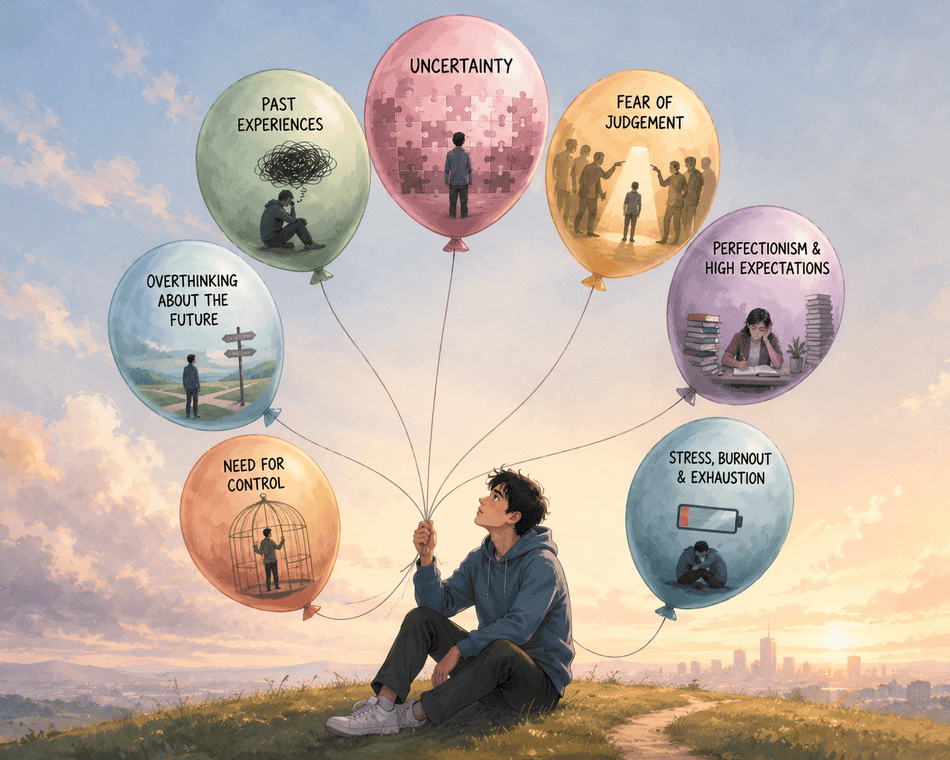
What triggers Overthinking? (It is not random)
People often describe overthinking as “thinking too much”, but it usually goes much deeper than that.
Overthinking is not simply a habit or personality flaw. In many cases, it is the mind’s attempt to protect you — from uncertainty, mistakes, emotional pain, rejection, or loss of control.
The problem is that the brain sometimes stays in protection mode for too long.
You replay conversations.
Analyse situations repeatedly.
Imagine worst-case scenarios.
Prepare for problems that may never even happen.
And slowly, your thoughts begin to feel louder than the present moment itself.
So… Why does overthinking happen?
Overthinking is often influenced by a combination of biological, psychological, and social factors — also known as the biopsychosocial model.
This means your thoughts may be shaped by:
- emotional experiences
- personality patterns
- stress levels
- environment and relationships
- past trauma or criticism
- physical exhaustion
- anxiety tendencies or a natural predisposition toward worry
In simple words
Overthinking rarely appears randomly. There are usually underlying triggers behind it.
And understanding those triggers is often the first step toward managing them more gently.
Some most common triggers include:
- uncertainty about the future
- fear of judgement or rejection
- perfectionism and high expectations
- emotional hurt from past experiences
- stress, burnout, and exhaustion
- the need to stay in control
When the mind feels emotionally overwhelmed or unsafe, it starts analysing everything deeply in an attempt to prevent mistakes, disappointment, or pain.
And while overthinking may begin as a form of protection, over time it can become mentally exhausting. (Refer: 5 signs you are not Just Thinking)
Sometimes, healing does not begin by forcing the thoughts away — but by understanding what your mind has been trying to protect you from all along.